The world added a record 664 GW of solar in 2025 and crossed 3 terawatts of cumulative capacity — a milestone no other energy technology has reached this fast. Yet the industry's growth story has a shadow. In the UK alone, firefighters responded to more than 200 solar-related fires in a single year, and the number of PV fires is growing at roughly twice the rate of new installations (The Telegraph; Fire Safety Matters, Aug 2026). The pattern repeats worldwide: a large PV construction site in Tuscany caught fire in August, rooftop arrays burned in multiple Chinese cities this year, and Los Angeles declared a state of emergency in June after flames reached rooftop solar installations. Scale, it turns out, is exposing a safety gap.
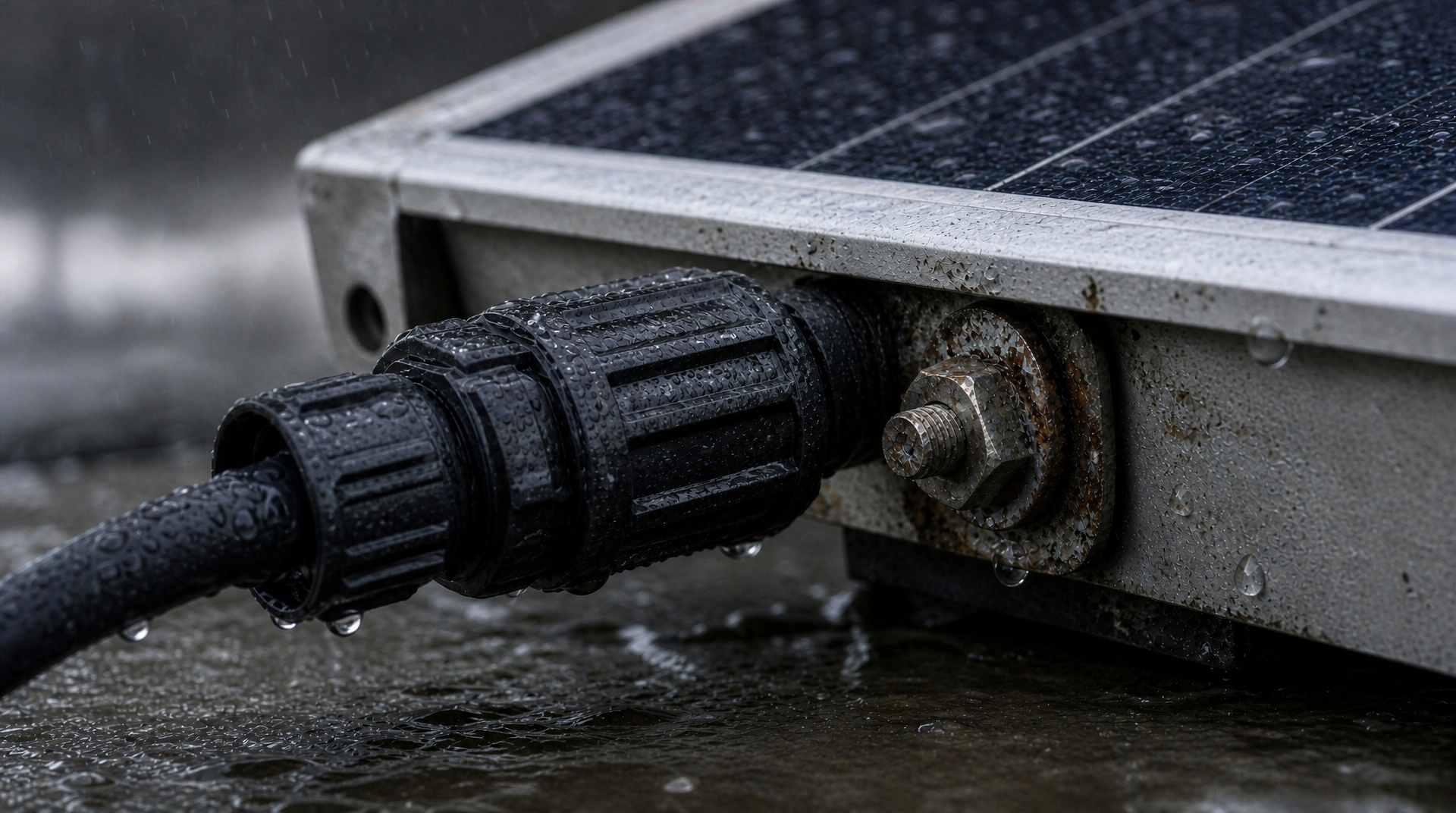
Most PV fires start where the metal meets.
Photovoltaic arrays operate at hundreds of volts DC — and unlike AC, DC current has no natural zero-crossing. Once an arc ignites, it sustains itself until the circuit is physically isolated. A large share of documented failures originate not in the module but in the interconnection layer: connectors, cable joints and junction boxes. Moisture finds its way past a degraded seal, corrosion raises contact resistance, heat builds at the junction, and under sustained string current a hot contact becomes a DC arc. Compounding the problem, the fastest-growing segments — rooftop residential and commercial systems — are precisely the ones with the least scheduled inspection, so a corroding connection can develop silently for years. This is why connector sealing is a fire-safety decision, not just a reliability preference.
IP67 vs IP69K: the difference is the environment.
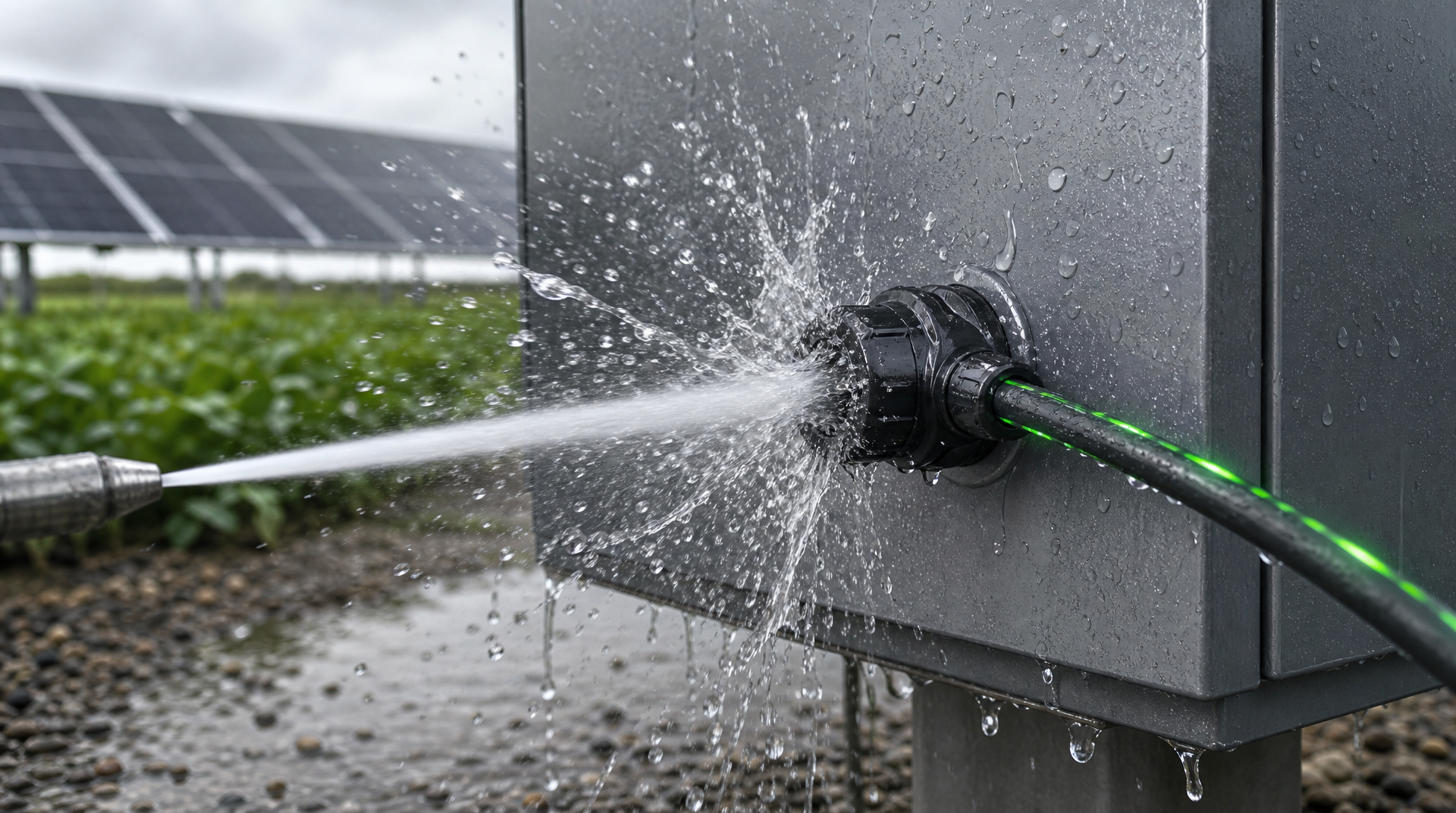
IP67 means dust-tight and protected against temporary immersion (1 m, 30 minutes) — adequate for a dry rooftop with occasional rain. IP69K goes further: dust-tight plus resistance to high-pressure, high-temperature water jet cleaning. The 9K test fires water at up to 80 °C and 100 bar from a fixed distance — an aggressive standard, but exactly the abuse that carport, agricultural and industrial rooftop sites endure during cleaning. The choice matters more than most spec sheets suggest. Coastal and humid sites face salt-laden condensation; agri-PV, carports and industrial rooftops are routinely pressure-washed. A connector rated only for immersion can pass its factory test and still fail its first cleaning season. For those environments, IP69K-rated connectors — sealed with double O-rings and built for the 1000 V DC class — close the gap between certification and field reality.
A safety-first connector checklist.
When specifying DC connectors for solar and storage circuits, verify four things. First, the IP rating should be backed by third-party test evidence, not a datasheet claim. Second, look for PV-specific standards — IEC 62852 and UL 6703 cover connectors for PV systems, and TÜV/CE/UL certifications document the voltage class and mating-cycle rating for 1000 V or 1500 V strings. Third, inspect the sealing and material design: double O-rings, strain relief, UV- and ozone-resistant housings and corrosion-resistant contacts determine the 20-year failure curve. Fourth, never mix connector brands on one string — brand mismatches are a documented cause of connector failure. Keep commissioning records, too: thermal imaging of DC junctions catches hot connections before they become arc sources. Pair the connectors with DC-rated isolators and surge protection, and the whole DC circuit gets defense in depth.
The takeaway.
Three terawatts is a milestone to celebrate — and a reason to tighten specification standards. As the installed base ages and extreme weather multiplies, connector inspection is moving from maintenance checklist to insurance requirement — and the buyers who specify safety-rated interconnects today will be the ones without fire claims tomorrow. Our EVQ waterproof connector series is engineered for exactly that: IP67/IP69K sealing, 1000 V DC rating and third-party-verifiable specs. Contact us to spec the right connection for your next solar project.


