Australian shipbuilder Incat has completed one of the most complex maritime loading operations ever undertaken at its Hobart yard. The world's largest battery-electric ship, known as Hull 096, was carefully manoeuvred onto the semi-submersible heavy-lift vessel Black Marlin, which ballasted down below the waterline so the 130-metre ferry could be positioned above its submerged cargo deck. Once secured, Black Marlin refloated and lifted the vessel clear of the water ahead of its delivery voyage.
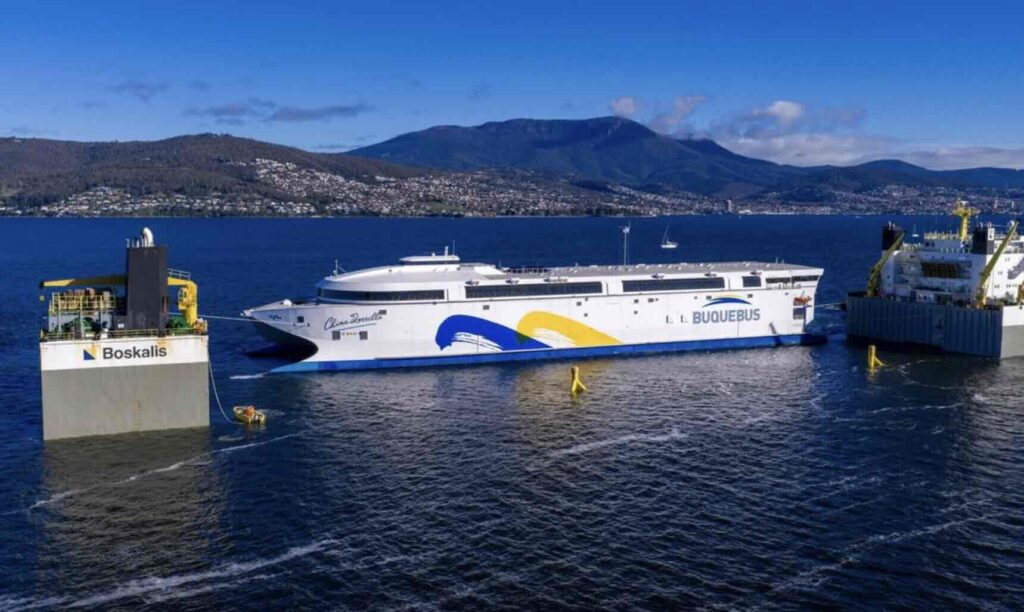
Hull 096 departed on 5 August 2026 and is expected to spend roughly 40 days in transit before reaching South America. Built for South American ferry operator Buquebus, the vessel will undergo final commissioning on arrival and then enter service across the River Plate region between Argentina and Uruguay.
Incat chairman Robert Clifford called the moment "extraordinary" for the future of sustainable maritime transport, describing it as the most significant project in the company's history. The loading concludes years of design, engineering and construction at Incat's Hobart shipyard and marks a major milestone in proving that large-capacity battery-electric ferries can move from concept to commercial reality. The project also highlights Tasmania's growing role as a hub for next-generation maritime technology, with the vessel designed and built entirely in Australia before its journey to one of the southern hemisphere's busiest ferry corridors.


